Peptide Research
What Is GH?
Growth Hormone (GH), also known as somatotropin, is a protein hormone naturally produced by the anterior pituitary gland.
GH plays an important role in biological processes related to growth, metabolism, and tissue maintenance. In scientific research, GH is frequently studied to better understand endocrine signaling, metabolic regulation, and communication within the hypothalamic–pituitary axis.
Researchers examine GH activity to investigate hormone regulation, secretion patterns, and feedback mechanisms involved in maintaining hormonal balance.
Reference: Giustina & Veldhuis, 1998
What Is GHRH?
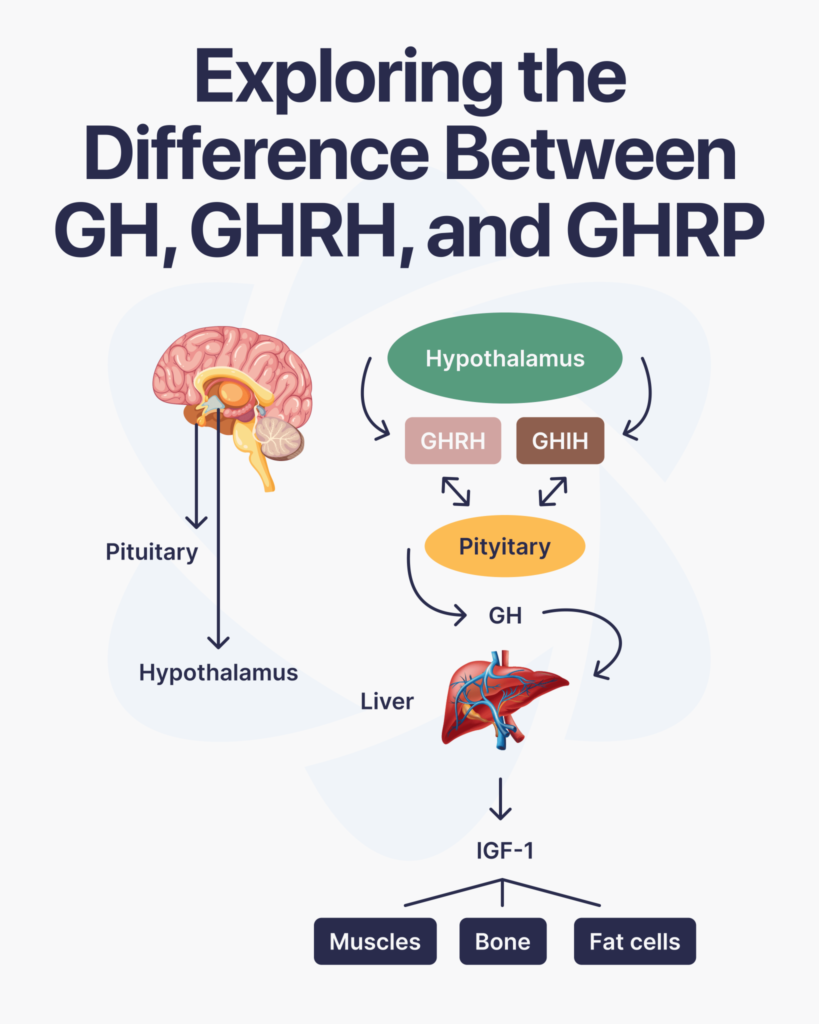
Growth Hormone–Releasing Hormone (GHRH) is a naturally occurring peptide produced in the hypothalamus.
Its primary role in research models is to study how signals from the hypothalamus influence growth hormone release from pituitary cells. GHRH interacts with specific receptors on pituitary cells and activates intracellular pathways, including:
- cAMP signaling.
- Calcium-related cellular responses.
Research involving GHRH has contributed to a better understanding of how the nervous system regulates hormone secretion patterns and biological rhythms.
Reference: Mayo, 1992
What Are GHRPs?
Growth Hormone–Releasing Peptides (GHRPs) are synthetic compounds studied for their ability to interact with growth hormone secretagogue receptors (GHS-R1a).
Unlike GHRH, which acts through GHRH receptors, GHRPs influence GH-related signaling through a separate receptor pathway.
Examples of GHRPs studied in laboratory research include:
- GHRP-2.
- GHRP-6.
- Ipamorelin.
Researchers investigate these compounds to better understand:
- Growth hormone regulation.
- Receptor activity.
- Communication between hypothalamic and pituitary signaling pathways.
Reference: Smith et al., 1997
Key Differences Between GH, GHRH, and GHRPs
Although these molecules are connected within the same biological system, they represent different components of growth hormone regulation.
GH (Growth Hormone)
GH is the hormone itself, produced and released by the pituitary gland. Research focuses on understanding its biological effects and signaling pathways.
GHRH (Growth Hormone–Releasing Hormone)
GHRH is a natural hypothalamic peptide that signals the pituitary gland through its specific receptor pathway to regulate GH secretion.
GHRPs (Growth Hormone–Releasing Peptides)
GHRPs are synthetic research compounds that interact with growth hormone secretagogue receptors and are studied as tools for examining alternative GH signaling pathways.
How These Molecules Are Studied Together
GH, GHRH, and GHRPs represent different levels of the same regulatory system:
- GH → The final hormone released by the pituitary.
- GHRH → The natural signaling peptide from the hypothalamus.
- GHRPs → Synthetic compounds used to investigate GH-related receptor pathways.
Studying these components together helps researchers understand the complex communication network involved in endocrine regulation.
Reference: Korbonits, 2008
Research Applications
Scientists study GH, GHRH, and GHRPs to investigate:
- Hormone secretion mechanisms.
- Pituitary and hypothalamic signaling.
- Growth hormone receptor pathways.
- Endocrine feedback systems.
- Peptide-based research models.
References
- Giustina, A., & Veldhuis, J. D. (1998). Pathophysiology of the neuroregulation of growth hormone secretion in experimental animals and the human. Endocrine Reviews, 19(6), 717–797.
- Mayo, K. E. (1992). Molecular cloning and expression of a pituitary-specific receptor for growth hormone-releasing hormone. Endocrine Reviews, 13(4), 484–502.
- Smith, R. G., et al. (1997). Growth hormone secretagogues: Physiology and pharmacology. Endocrinology, 138(11), 5567–5573.
- Korbonits, M. (2008). Growth hormone secretagogues in clinical practice. Peptides, 29(1), 230–236.
Research Use Disclaimer
All products available through Aeturna Wellness are supplied exclusively for laboratory and scientific research purposes. They are not intended for human or animal consumption and are not approved to diagnose, treat, cure, or prevent any disease. The information provided on this page is intended solely for educational and informational purposes and should not be interpreted as medical advice or therapeutic guidance.