Peptide Research
What Is Semax?
Semax is a synthetic heptapeptide consisting of the amino acid sequence Met-Glu-His-Phe-Pro-Gly-Pro (MEHFPGP). It was developed from a fragment of adrenocorticotropic hormone (ACTH 4–7) with an additional Pro-Gly-Pro sequence.
In scientific research settings, Semax has been studied for its interactions with neural signaling pathways, molecular activity, and enzyme-related processes. Its chemical structure and peptide characteristics have been extensively described within scientific literature.
Reference: Magrì et al., 2016
What Is N-Acetyl Semax Amidate?
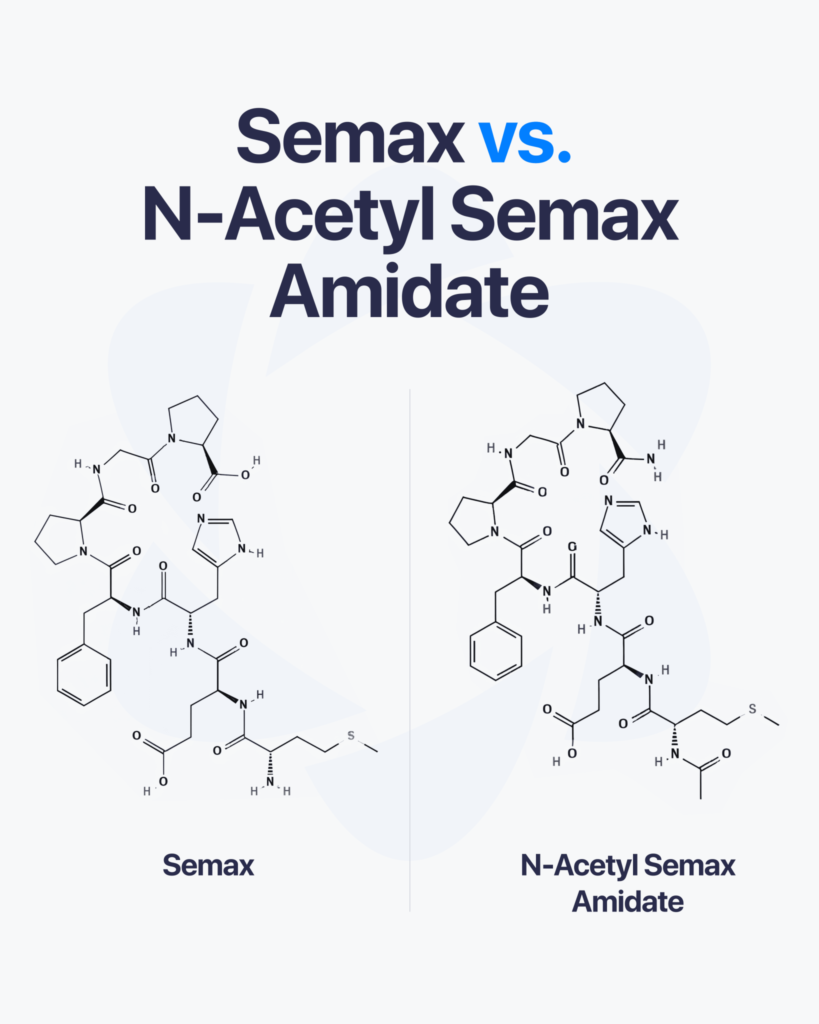
N-Acetyl Semax Amidate (Ac-Semax-NH₂) is a modified version of Semax that maintains the same seven-amino-acid sequence while incorporating two structural changes:
- N-terminal acetylation
- C-terminal amidation
These modifications are commonly explored in peptide research to examine how changes at the terminal ends of a molecule may influence stability, molecular interactions, and behavior in laboratory testing environments.
Reference: Magrì et al., 2016
Chemical Differences Between Semax and N-Acetyl Semax Amidate
Peptide Sequence
Both compounds share the same primary amino acid sequence:
MEHFPGP
The main difference is not within the peptide backbone itself, but in the chemical modifications applied to the peptide terminals.
Terminal Modifications
Semax contains free N- and C-terminal ends, while N-Acetyl Semax Amidate includes:
- An acetyl group added to the N-terminal end.
- An amide group added to the C-terminal end.
Researchers study these modifications because they may influence enzymatic breakdown, molecular stability, and behavior during laboratory assays.
Reference: Magrì et al., 2016
How Semax and N-Acetyl Semax Amidate Are Studied
Semax Research Background
Early research on Semax focused on understanding its peptide structure, enzymatic stability, and breakdown pathways. Studies examined how enzymes, including aminopeptidases, interact with Semax and related peptide fragments in biological environments.
References: Potaman et al., 1991; 1993
N-Acetyl Semax Amidate Research
Research involving N-Acetyl Semax Amidate has focused on how terminal modifications may alter peptide characteristics. Studies have examined how acetylation and amidation influence factors such as molecular interactions, coordination behavior, and performance within experimental systems.
Reference: Magrì et al., 2016
Stability and Delivery Research
Scientific reviews exploring peptide delivery methods have investigated terminal modifications, formulation strategies, and other approaches designed to improve peptide handling during laboratory research.
N-acetylation is one modification researchers examine when evaluating peptide stability and behavior in experimental models.
Reference: Shevchenko et al., 2019
Research Advantages
Well-Characterized Parent Peptide
Semax has a documented research history, including studies examining its sequence, structure, and degradation pathways. This provides researchers with a strong foundation for comparative investigations.
References: Potaman et al., 1991; 1993
Controlled Study of Terminal Modifications
N-Acetyl Semax Amidate allows researchers to investigate how terminal modifications influence peptide characteristics while maintaining the original amino acid sequence.
This makes it useful for comparative studies focused on molecular behavior and assay performance.
Reference: Magrì et al., 2016
Research Method Development
Peptide modifications such as acetylation and amidation are commonly studied as tools for understanding peptide stability, handling, and performance within laboratory models.
Reference: Shevchenko et al., 2019
Research Considerations
Enzymatic Breakdown
Semax has been shown to interact with enzymes responsible for peptide degradation. Researchers account for these factors when designing experiments involving biological samples or incubation studies.
References: Potaman et al., 1991; 1993
Modified Molecular Behavior
Because N-Acetyl Semax Amidate contains structural modifications, its molecular interactions and experimental behavior may differ from the original Semax peptide in certain research applications.
Reference: Magrì et al., 2016
Limited Comparative Data
Although Semax has a longer history of published research, direct comparative studies between Semax and N-Acetyl Semax Amidate remain more limited. Additional research continues to explore the differences between these peptide structures.
References
- Magrì, A., et al. (2016). Research on Semax structure, modifications, and peptide properties.
- Potaman, V. N., et al. (1991; 1993). Studies examining Semax sequence, enzymatic sensitivity, and degradation pathways.
- Shevchenko, Y., et al. (2019). Reviews on peptide delivery strategies and stability approaches.
Research Use Disclaimer
All products provided by Aeturna Wellness are intended exclusively for laboratory and scientific research purposes. They are not intended for human or animal consumption and are not approved to diagnose, treat, cure, or prevent any disease. The information presented on this page is provided solely for educational and scientific research purposes and should not be considered medical advice or therapeutic guidance.