Peptide Research
What Is Lyophilization?
Lyophilization, commonly known as freeze-drying, is a preservation technique widely used in scientific and pharmaceutical research laboratories to stabilize sensitive biological materials.
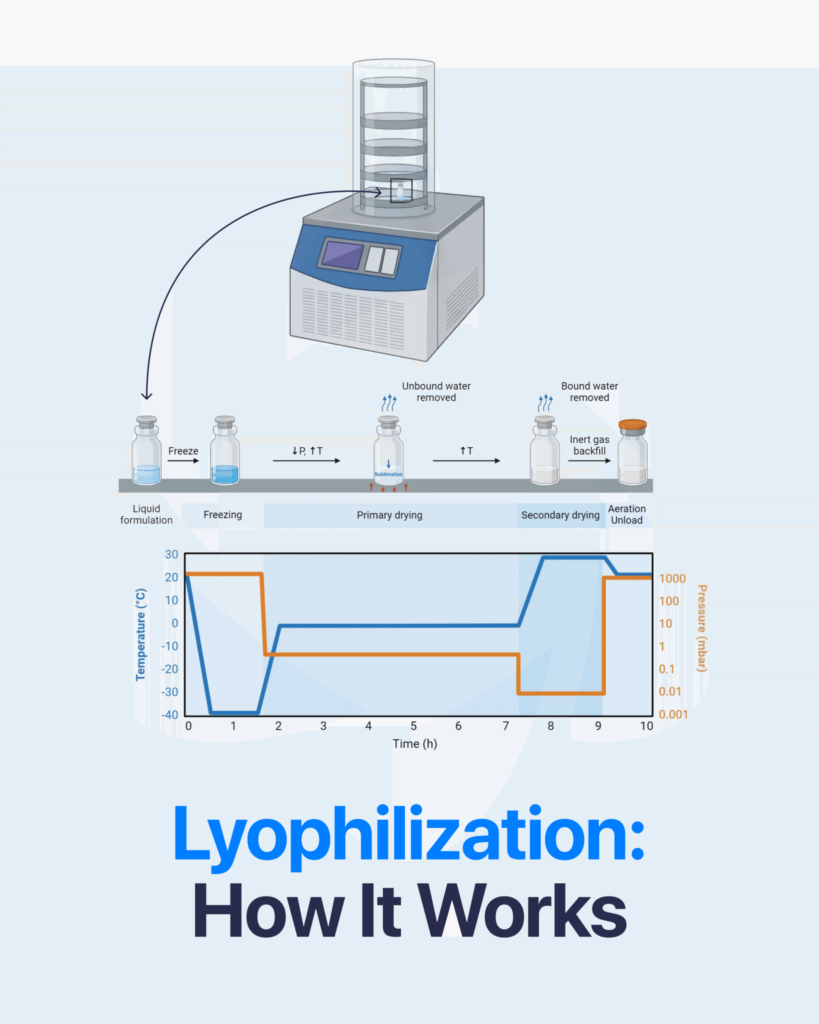
The process removes water from a frozen sample through sublimation, where ice transitions directly from a solid state into vapor without becoming liquid. By reducing moisture content while maintaining structural integrity, lyophilization helps preserve delicate compounds such as peptides, proteins, and other biological materials.
Reference: Tang & Pikal, 2004
How Does Lyophilization Work?
The freeze-drying process generally involves three primary stages:
Freezing
The sample is cooled to a low temperature, causing water to form ice crystals. This creates a stable frozen structure that protects the material during the drying process.
Primary Drying (Sublimation)
During this stage, pressure is reduced while controlled heat is applied. The frozen water converts directly into vapor, allowing moisture removal without passing through the liquid phase.
Secondary Drying (Desorption)
The final stage removes remaining bound water molecules from the sample, further reducing moisture levels and improving long-term stability.
Reference: Franks, 1998
Why Lyophilization Is Used in Research
Many biological compounds are sensitive to environmental conditions and may degrade when stored in liquid form. Lyophilization provides researchers with a method to improve stability, simplify storage, and support controlled preparation for laboratory applications.
For peptides and proteins, freeze-drying can help:
- Reduce degradation during storage.
- Improve handling and transportation.
- Extend research sample stability.
- Allow accurate reconstitution before experimental use.
The technique can be applied to both small-scale laboratory samples and larger production environments.
Reference: Wang, 2000
Applications of Lyophilization in Laboratory Research
Researchers use lyophilization for various scientific applications, including:
Peptide and Protein Preservation
Maintaining stability and extending the usable storage period of sensitive peptide and protein samples.
Biological Material Stabilization
Supporting the preservation of vaccines, biologics, and other temperature-sensitive research materials.
Analytical Research Standards
Preparing stable reference materials used in analytical techniques such as:
- High-performance liquid chromatography (HPLC).
- Mass spectrometry analysis.
Controlled Sample Preparation
Allowing researchers to reconstitute dried materials under specific conditions for laboratory studies and experimental models.
References
- Franks, F. (1998). Freeze-drying of bioproducts: Putting principles into practice. European Journal of Pharmaceutics and Biopharmaceutics, 45(3), 221–229.
- Tang, X., & Pikal, M. J. (2004). Design of freeze-drying processes for pharmaceuticals: Practical advice. Pharmaceutical Research, 21(2), 191–200.
- Wang, W. (2000). Lyophilization and development of solid protein pharmaceuticals. International Journal of Pharmaceutics, 203(1–2), 1–60.
Research Use Disclaimer
All products available through Aeturna Wellness are supplied exclusively for laboratory and scientific research purposes. They are not intended for human or animal consumption and are not approved to diagnose, treat, cure, or prevent any disease. The information provided on this page is intended solely for educational and informational purposes and should not be interpreted as medical advice or therapeutic guidance.