Peptide Research
What Are Amino Acids?
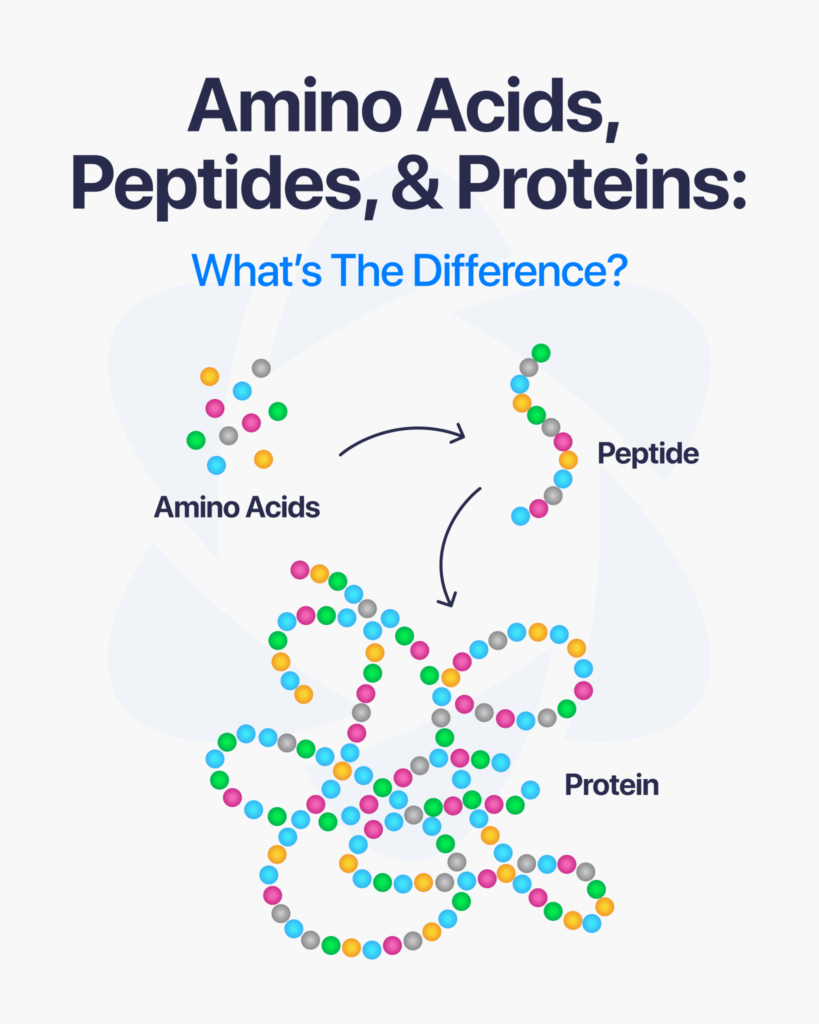
Amino acids are the fundamental building blocks that form peptides and proteins. Each amino acid contains a central carbon atom connected to four key components:
- An amino group.
- A carboxyl group.
- A hydrogen atom.
- A unique side chain, known as the R-group.
The structure of each side chain determines an amino acid’s chemical characteristics, including properties such as polarity, charge, and interactions with other molecules.
Because amino acids determine the structure and behavior of larger biological molecules, they are essential subjects in biochemical and molecular research.
What Are Peptides?
Peptides are short chains of amino acids connected through peptide bonds. These bonds form when the carboxyl group of one amino acid reacts with the amino group of another, releasing a water molecule during the process.
In laboratory research, synthetic peptides are commonly created to study biological signaling, molecular interactions, enzyme activity, and structural relationships.
Generally, peptides are described as chains containing approximately 2 to 50 amino acids, although the exact classification can vary depending on scientific context.
What Are Proteins?
Proteins are larger and more complex biological molecules made up of long chains of amino acids. Many proteins contain hundreds or even thousands of amino acid residues that fold into specific three-dimensional structures.
This complex folding determines how proteins interact with other molecules and perform biological functions.
Proteins can serve many roles, including:
- Enzymatic activity.
- Structural support.
- Molecular transport.
- Cellular signaling and receptor functions.
Research into protein structure, folding, and misfolding has contributed significantly to understanding complex biological processes and diseases associated with abnormal protein behavior.
Key Differences Between Amino Acids, Peptides, and Proteins
Size and Structure
- Amino acids: Individual molecular units that serve as the foundation for larger biological molecules.
- Peptides: Short chains of amino acids linked together by peptide bonds.
- Proteins: Larger amino acid chains that fold into complex three-dimensional structures.
Molecular Organization
Amino acids have simple molecular structures, while peptides generally form shorter chains that may remain flexible or partially structured. Proteins typically develop stable three-dimensional conformations that define their biological roles.
Biological Function
Each plays a different role in biological research:
- Amino acids act as essential building blocks for peptides and proteins.
- Peptides often function as signaling molecules and research tools for studying cellular communication.
- Proteins perform complex biological tasks, including catalysis, transport, and structural organization.
Research Applications
Scientists study amino acids, peptides, and proteins to better understand:
- Molecular structure and interactions.
- Cellular signaling pathways.
- Enzyme mechanisms.
- Protein folding and stability.
- Biological communication systems.
Research Use Disclaimer
All products offered by Aeturna Wellness are supplied exclusively for laboratory and scientific research purposes. They are not intended for human or animal consumption and are not approved to diagnose, treat, cure, or prevent any disease. The information provided on this page is intended solely for educational and informational purposes and should not be interpreted as medical advice or therapeutic guidance.