Peptide Research
What Are Excipients?
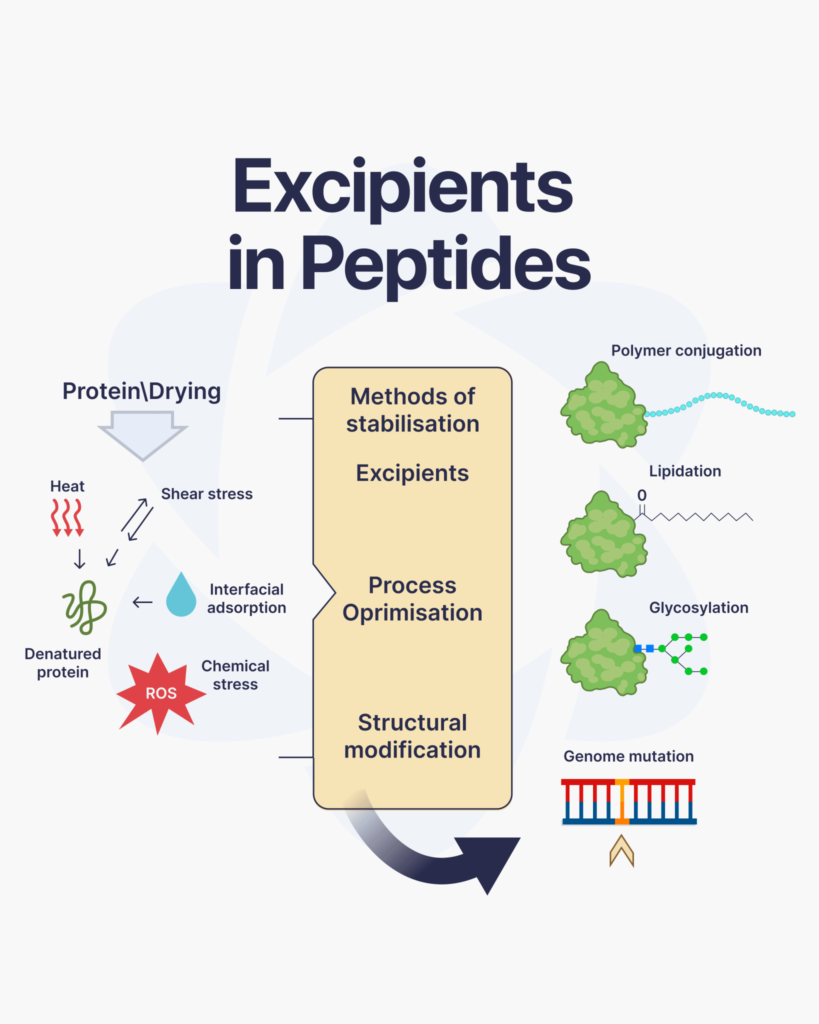
Excipients are inactive ingredients added alongside an active research compound to support formulation stability, handling, and storage. In peptide research, excipients play an important role in maintaining peptide integrity and improving the consistency of laboratory preparations.
Although excipients do not provide the primary biological activity being studied, they can help protect peptides from degradation and support reliable performance during storage and experimental use.
Reference: Rowe et al., 2006
Why Are Excipients Important in Peptide Research?
Peptides are delicate biological molecules that may be affected by environmental conditions such as:
- Temperature changes.
- Light exposure.
- Moisture.
- Oxidation.
- Chemical instability.
Researchers use excipients to help minimize these challenges and maintain sample quality.
Common functions of excipients include:
- Reducing peptide aggregation.
- Supporting chemical stability.
- Improving solubility.
- Maintaining suitable pH conditions.
- Acting as stabilizing agents during freeze-drying (lyophilization).
Reference: Maa & Hsu, 1996
Common Excipients Used in Peptide Formulations
Mannitol and Trehalose
These compounds are commonly studied as stabilizing agents during lyophilization. They can help protect peptide structures during freezing and drying processes.
Arginine and Glycine
Certain amino acids, including arginine and glycine, are investigated for their ability to improve solubility and reduce unwanted peptide aggregation in research formulations.
Buffers
Buffer systems, such as phosphate and citrate buffers, help maintain consistent pH and ionic conditions during storage and laboratory applications.
Polysorbates
Surfactants such as polysorbate 20 and polysorbate 80 are commonly researched for their ability to reduce surface interactions and help minimize aggregation.
Reference: Wang, 2000
Research Applications of Excipients
Excipients are not investigated for direct biological effects of their own. Instead, they are essential tools used to support accurate and reproducible research.
In peptide studies, excipients may help:
- Preserve peptide stability in storage containers.
- Maintain consistent sample preparation.
- Improve repeatability in laboratory assays.
- Ensure that observed experimental results are related to the peptide being studied rather than sample degradation.
By supporting formulation consistency, excipients contribute to reliable peptide research outcomes.
Reference: Carpenter et al., 2002
References
- Rowe, R. C., et al. (2006). Handbook of Pharmaceutical Excipients. Pharmaceutical Press.
- Maa, Y. F., & Hsu, C. C. (1996). Protein denaturation by freeze-drying: Stabilization by excipients. Journal of Pharmaceutical Sciences, 85(10), 1050–1056.
- Wang, W. (2000). Lyophilization and development of solid protein pharmaceuticals. International Journal of Pharmaceutics, 203(1–2), 1–60.
- Carpenter, J. F., et al. (2002). Rational design of stable protein formulations: Theory and practice. Journal of Controlled Release, 78(1–3), 1–9.
Research Use Disclaimer
All products offered by Aeturna Wellness are supplied exclusively for laboratory and scientific research purposes. They are not intended for human or animal consumption and are not approved to diagnose, treat, cure, or prevent any disease. The information provided on this page is intended solely for educational and informational purposes and should not be interpreted as medical advice or therapeutic guidance.