Peptide Research
What Is Peptide Synthesis?
Peptide synthesis is a scientific process used to create short chains of amino acids connected through peptide bonds. These laboratory-produced peptides can replicate naturally occurring sequences or be specifically designed to investigate unique biological interactions.
Because peptides are involved in many areas of biology, including cellular signaling, enzyme activity, and structural processes, synthetic peptide production allows researchers to study these molecules in controlled laboratory environments.
How Peptide Synthesis Is Performed
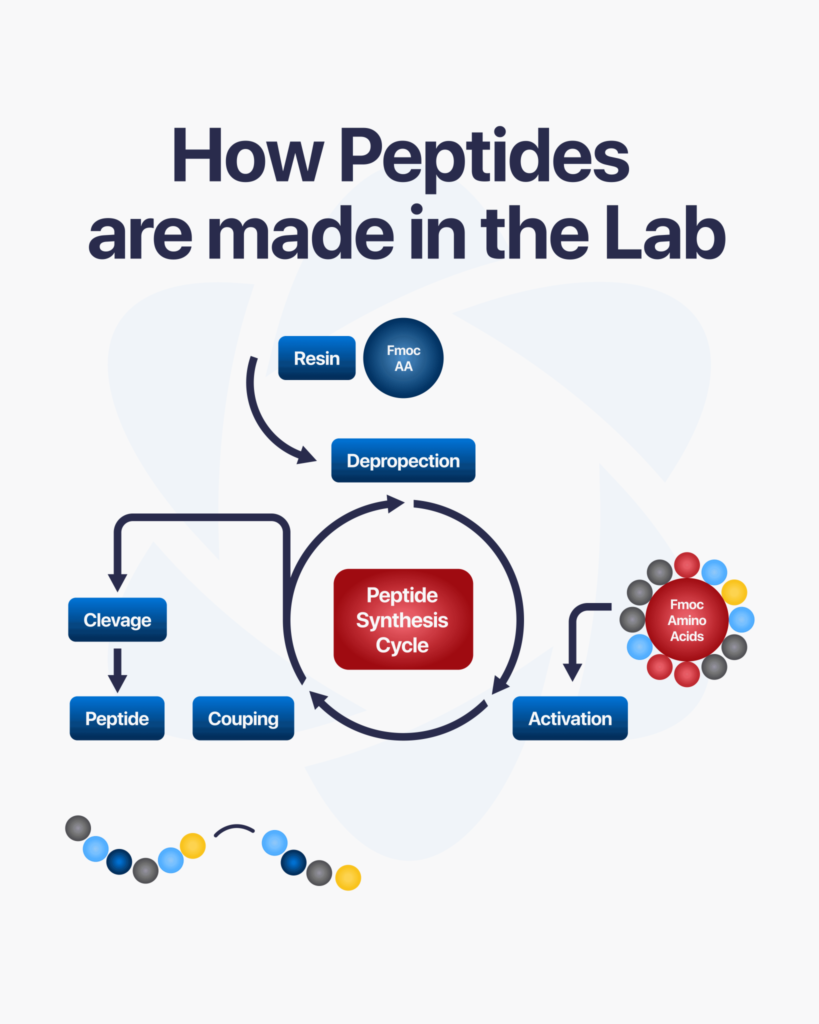
The most widely used method for producing synthetic peptides is solid-phase peptide synthesis (SPPS).
In this approach, the peptide chain is assembled step by step while attached to a solid resin support. Individual amino acids are added in a controlled sequence until the desired peptide structure is completed.
Each synthesis cycle typically includes three main stages:
Activation
The next amino acid is chemically prepared to enable attachment to the growing peptide chain.
Coupling
A peptide bond is formed between the newly activated amino acid and the existing chain.
Deprotection
Protective chemical groups are removed, allowing the next amino acid to be added during the following synthesis cycle.
After the complete sequence has been assembled, the peptide is separated from the resin and undergoes purification and analytical testing.
Key Features of Synthetic Peptide Production
Sequence Precision
Synthetic methods allow researchers to create peptides with specific amino acid sequences, enabling detailed investigation of structure and function relationships.
Design Flexibility
Researchers can incorporate specialized modifications, including:
- Non-natural amino acids.
- Molecular labels.
- Structural modifications.
These approaches allow scientists to examine how changes in peptide structure influence biological behavior.
Production Scalability
Peptide synthesis techniques can be adapted for different research requirements, from small quantities used in laboratory experiments to larger amounts needed for advanced analytical studies.
Quality and Purity Analysis
Synthetic peptides are commonly evaluated using analytical methods such as:
- High-performance liquid chromatography (HPLC).
- Mass spectrometry.
These techniques help confirm peptide identity, composition, and purity for research applications.
Advances in Peptide Synthesis Research
The development of automated peptide synthesizers has significantly improved the efficiency, consistency, and reproducibility of peptide production.
Recent advances in:
- Coupling chemistry.
- Resin technologies.
- Purification methods.
have helped researchers improve synthesis outcomes and reduce unwanted byproducts.
However, producing very long peptides or highly hydrophobic sequences can still present technical challenges and may require specialized approaches or optimized synthesis conditions.
Research Applications
Synthetic peptide production enables scientists to investigate:
- Peptide structure and function relationships.
- Cellular signaling pathways.
- Protein interactions.
- Enzyme-related mechanisms.
- Development of new research compounds.
Research Use Disclaimer
All products available through Aeturna Wellness are supplied exclusively for laboratory and scientific research purposes. They are not intended for human or animal consumption and are not approved to diagnose, treat, cure, or prevent any disease. The information provided on this page is intended solely for educational and informational purposes and should not be interpreted as medical advice or therapeutic guidance.